
MEET THE SPEAKER
When space is limited, how can a school still give learning room to grow?
In cities where land is scarce and every square metre carries value, designing a school is a complex exercise in priorities. The challenge is not simply to accommodate classrooms, but to create an environment that supports movement, interaction, collaboration, play, safety and connection.
So, how can architecture make a constrained footprint work harder for learning?
This is one of the questions Ar. Rohit Bhatkar brings to PULSE 2026 — offering architects, designers, educators and school leaders a closer look at how thoughtful spatial planning can respond to the realities of urban education.
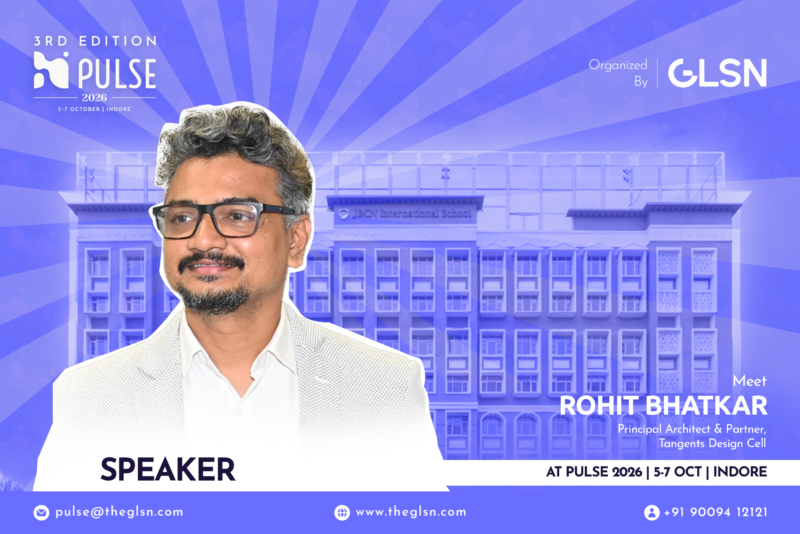
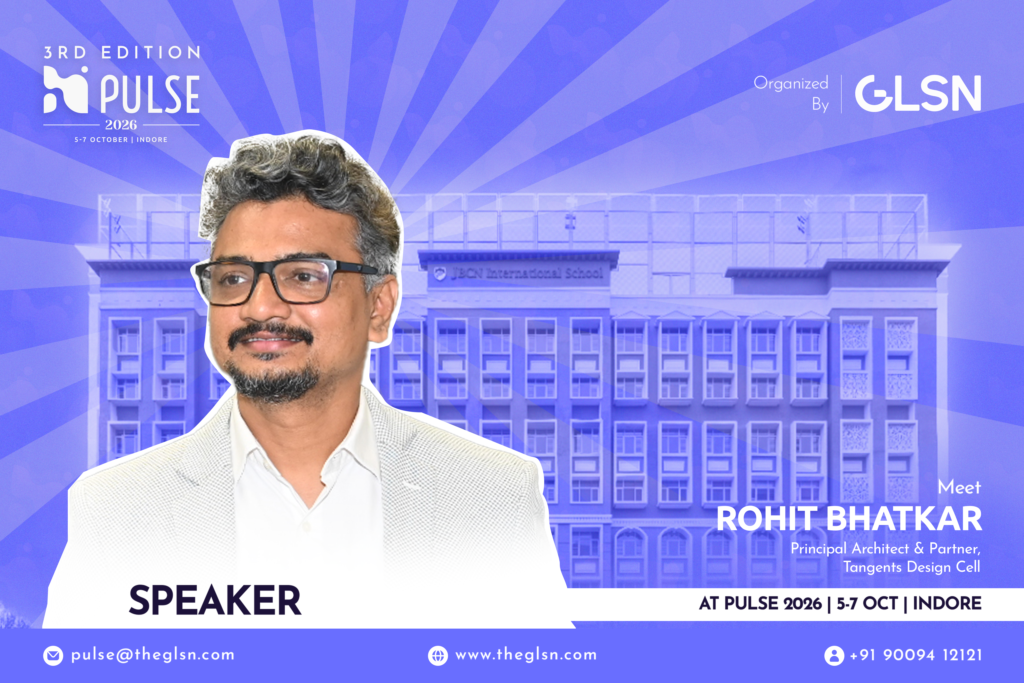
Rohit Bhatkar
Principal Architect & Partner, Tangents Design Cell (TDC), Mumbai
With experience spanning large-scale architecture, institutional projects and architectural education, Rohit brings a practice-led perspective to the design of environments where people learn, work and interact.
He began his professional journey in Mumbai and later worked as a Lead Architect with Gherzi Eastern Ltd., where he was involved in large-scale commercial and industrial projects. He subsequently became a principal architect at Tangents Design Cell, working alongside Ar. Prashant Sukhatankar.
Today, TDC’s practice extends across architecture and interior design, with projects spanning institutional, residential and hospitality environments. Its approach considers context, spatial functionality, material sensitivity, user aspirations and budget realities as connected parts of the design process.
Rohit also brings the perspective of an educator, serving as design faculty at architectural institutions. This intersection of practice and teaching allows him to engage with both the realities of professional design and the evolving thinking of the next generation of architects.
Designing Beyond the Classroom
Educational architecture makes these questions especially significant.
TDC’s work on JBCN International School, Chembur reflects an approach that considers the requirements and sensitivities of young learners, incorporating collaborative working and carefully considered spatial environments into the school experience.
For an urban school, the learning environment cannot stop at the classroom door.
Corridors become routes for movement. Shared spaces become opportunities for interaction. Vertical circulation becomes part of the daily experience. And planning decisions begin to influence how learners gather, participate and connect.
This shifts the architectural question from:
“How much can we fit into the site?”
to:
“What kind of learning experience can the site make possible?”
That shift is particularly relevant to cities such as Mumbai, where educational institutions often have to respond to demanding urban conditions and limited footprints.
What Rohit Brings to PULSE 2026
At PULSE 2026 | Where Culture Meets Learning, Rohit brings this architectural reality into a wider conversation about how environments influence learning.
For architects and interior designers, his perspective offers an opportunity to examine how context, functionality, material and spatial planning can shape educational environments.
For school leaders, founders and campus planners, it raises practical questions about how a school can support more than academic instruction — creating places for movement, collaboration, interaction and everyday discovery.
For educators, it offers another way to think about the environment around the learner: not simply as infrastructure, but as a part of the learning experience itself.
And for anyone involved in creating or transforming a school, it brings one important question into focus:
If every part of a school can influence how learners experience their day, how intentionally should we design it?
Where Culture Meets Learning
This question connects directly to the spirit of PULSE 2026.
At GLSN, the conversation around learning spaces extends beyond aesthetics and architecture. It looks at the relationship between people, place, culture, behaviour and learning – and how these elements come together to shape meaningful educational environments.
Rohit’s practice adds an important urban perspective to that conversation: how can architectural design respond to real constraints while keeping the learner’s experience at the centre?
His presence at PULSE offers the audience an opportunity to explore the thinking behind vertical learning environments, spatial efficiency and learner-centred design – and to consider how the architecture of a school can support the culture of learning within it.
PULSE 2026 | Where Culture Meets Learning
5–7 October 2026 | Sheraton Grand Palace, Indore
For architects, interior designers, school leaders, educators and campus planners shaping the next generation of learning environments – Rohit’s perspective is one to bring into the room.