
Author. Ar. Paras Sareen Principal Landscape Architect PSA Landscape Architects
The landscape of a school is rarely neutral. It quietly participates in shaping the intellectual and emotional development of children during their most formative years. Yet in many educational campuses, the outdoor environment is treated as a residual space- an assemblage of sports fields, paved courts, and ornamental planting that frames buildings rather than contributing meaningfully to the educational experience.
For landscape architects, however, the school ground represents a profound opportunity. In childhood, daily interactions with outdoor environments begin to shape one’s earliest understanding of nature, community, and belonging. When thoughtfully designed, the school landscape transcends being mere open space and operates as a living system- an ecological and psychological framework that supports learning beyond the classroom.

Landscape as Ecological Pedagogy
Children develop their understanding of the world through observation and repeated sensory experience. A landscape that makes ecological processes visible- rather than hiding them- can function as an active pedagogical tool.
Planting structures that incorporate native species, layered vegetation, and habitats for birds and insects introduce children to biodiversity in tangible ways. Rain gardens, bioswales, and permeable surfaces can reveal hydrological processes that are otherwise hidden within conventional infrastructure. Edible gardens and orchards allow students to experience seasonal cycles of growth, decay, and renewal.
In such landscapes, ecology becomes visible and experiential. Children observe pollinators interacting with flowering plants, witness the seasonal transformations of trees, and recognize how rainwater infiltrates soil instead of being diverted into drains.
By hosting miniature ecosystems of flora and fauna, school landscapes allow children to experience themselves as participants within a larger ecological system, fostering empathy for the living world around them. These encounters gradually foster an intuitive understanding of environmental interdependence.
The school campus thus becomes an early site of ecological literacy- one that subtly communicates an important philosophical idea: human life exists within a broader community of living organisms.
Psychological Landscapes of Childhood
While ecological awareness is a central dimension of school landscapes, their psychological role is equally significant. Environmental psychologists have long documented the restorative qualities of natural environments, particularly for children whose daily routines are structured by academic pressure and social complexity.
Access to green spaces has been shown to improve concentration, reduce cognitive fatigue, and support emotional regulation.
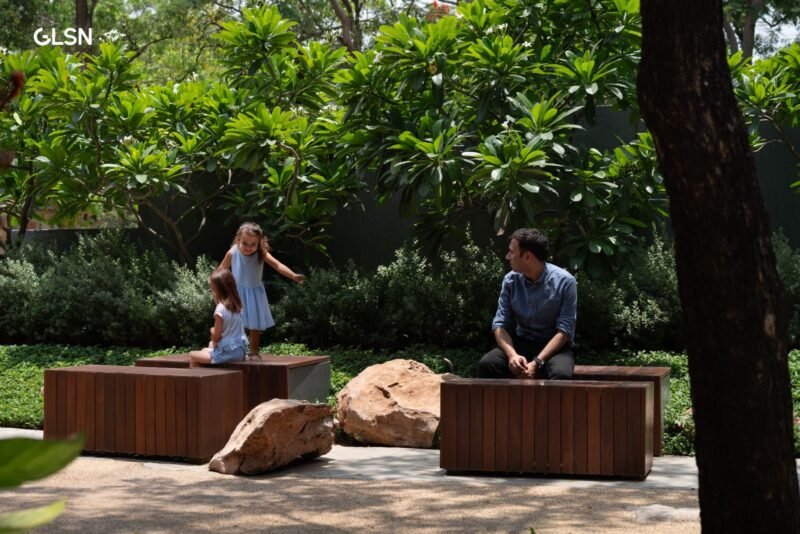
Within school environments, landscapes therefore serve as critical zones of restoration. Courtyards shaded by tree canopies create spaces of comfort and informal social interaction. Informal lawns and planted edges create adaptable spaces where children can sit, read, converse, or quietly observe their surroundings.Landscapes that incorporate varied topography, rocks, logs, and vegetation encourage exploratory play and imaginative engagement.
Alongside active spaces, quieter landscapes—small gardens and shaded seating areas or contemplative corners where children can retreat from the intensity of collective environments. These subtle spatial differences acknowledge the diverse psychological needs of students.
Through such spatial qualities, the landscape becomes part of the emotional infrastructure of the school.
Designing for Curiosity Rather Than Control
Modern educational environments often prioritize order, visibility, and control. While safety remains essential, excessively regulated landscapes risk eliminating the sensory richness that allows children to develop meaningful relationships with their surroundings.
A landscape designed for curiosity engages multiple senses. The texture of bark, the fragrance of flowering plants, the movement of grasses in wind, or the shifting patterns of shade beneath trees create subtle yet memorable experiences.
These sensory encounters help cultivate what environmental philosophers often describe as affective relationships with nature- emotional bonds that later influence environmental attitudes and stewardship. Landscape architects therefore face a delicate balance: designing environments that remain safe and legible while preserving the complexity and unpredictability that characterize natural systems.
Precedents: Schools that Integrate Landscape and Learning
Several contemporary educational environments demonstrate how landscape can operate as a central component of learning.
At Green School Bali in Indonesia, the campus is conceived almost entirely as an ecological environment. Open-air bamboo structures are embedded within a landscape of forests, gardens, and agricultural systems. Students interact daily with permaculture gardens, water systems, and natural habitats, allowing environmental education to occur through lived experience rather than abstraction.
Similarly, Fuji Kindergarten in Tokyo, designed by architect Takaharu Tezuka, places landscape at the center of childhood exploration. The circular building surrounds a courtyard where mature trees emerge through the roof structure itself. Children climb, run, and gather around these trees, making them both physical anchors and symbolic elements of daily life.
In the United States, the campus of Sidwell Friends School in Washington, D.C. demonstrates how ecological infrastructure can become an educational landscape. Its constructed wetlands treat wastewater on-site while simultaneously serving as a visible ecological system. Students observe how water flows through planted terraces and filtration zones, transforming a technical process into a living laboratory.
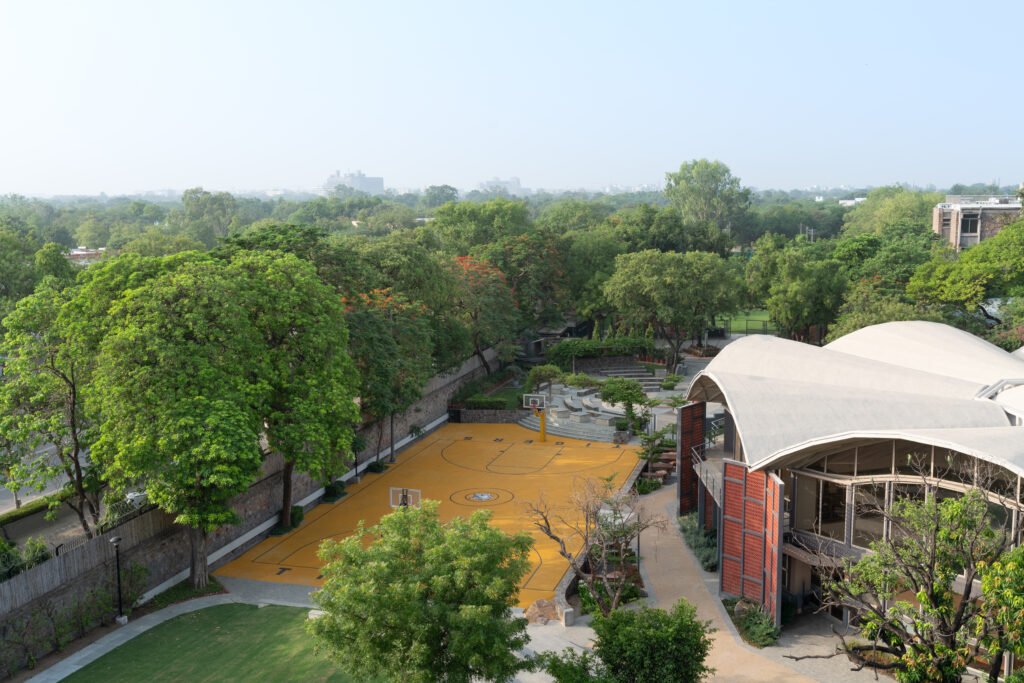
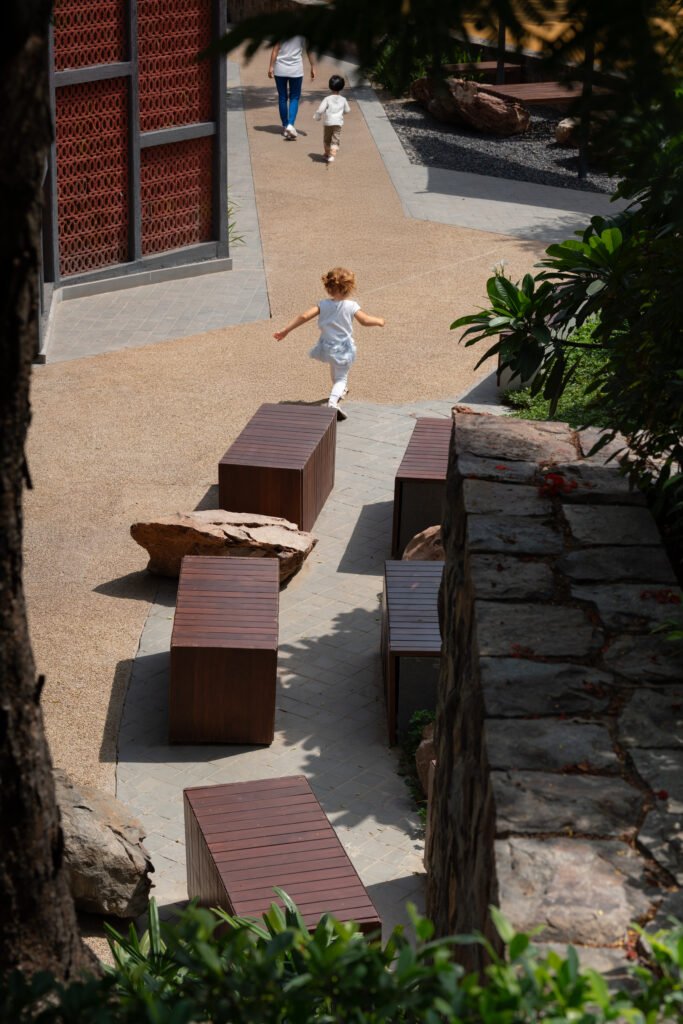
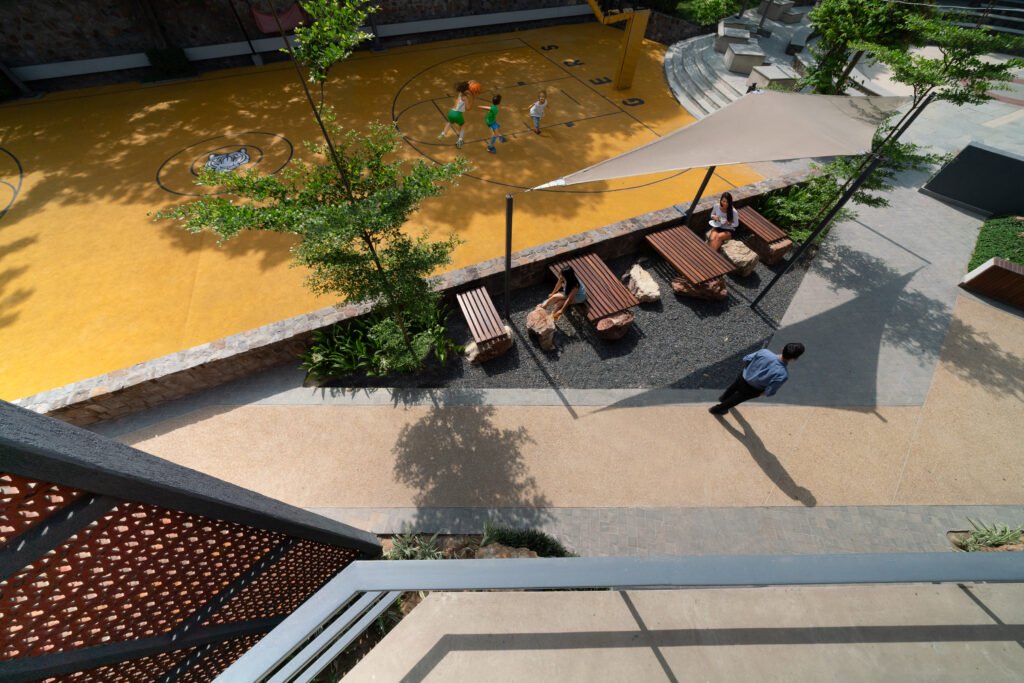
Similarly, the campus of the American Embassy School in New Delhi, designed by us, demonstrates how landscape can respond to both ecological context and everyday learning. The design builds upon the architectural legacy of Joseph Allen Stein, integrating new outdoor environments around the workshops and cafeteria while remaining sensitive to the character of the original campus. Circulation paths form a connective spine, linking play areas, gathering zones, and informal seating into a cohesive network of outdoor spaces.
The landscape also draws inspiration from the dry scrub ecology of the nearby Delhi Ridge, introducing native and adaptive planting that improves permeability and supports local biodiversity. Existing rock outcrops are transformed into stepped seating terraces, while a mist-infused water feature creates a cool microclimate during Delhi’s intense summers. Through these elements, the campus landscape becomes both a social setting for interaction and an environmental system that students experience in their everyday routines.
These examples reveal an important shift: the landscape is no longer peripheral to the school but becomes a primary medium through which learning occurs.
Toward Landscapes of Learning
A well-conceived school landscape operates simultaneously as:
- a pedagogical environment, where ecological systems are visible and understandable
- a psychological refuge, supporting emotional balance and restorative experiences
- and a spatial framework for curiosity, encouraging exploration and imagination
When these dimensions converge, the school ground transcends its role as an open space around buildings. It becomes a formative environment—one that introduces children to the rhythms, complexity, and interdependence of the living world.
For many students, these landscapes may represent their first sustained relationship with nature. The responsibility of designing them, therefore, extends far beyond aesthetics or site planning. It is, ultimately, a question of how the next generation will come to understand the planet they inhabit.
