
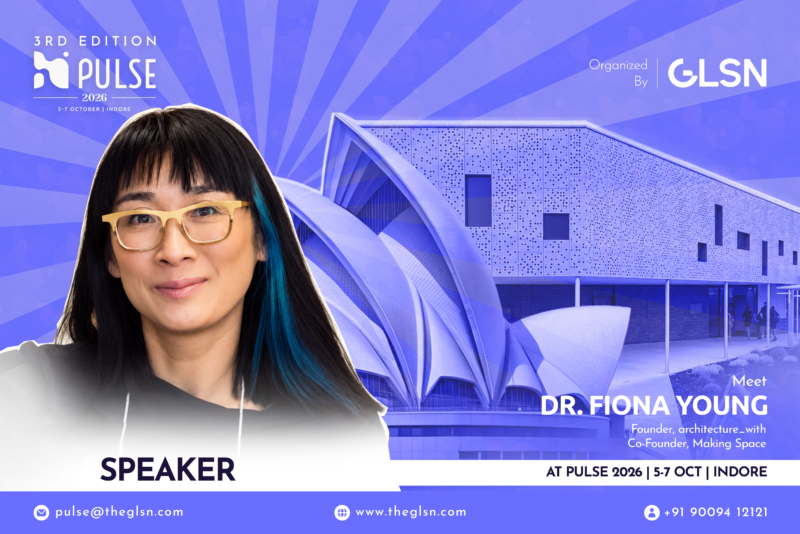
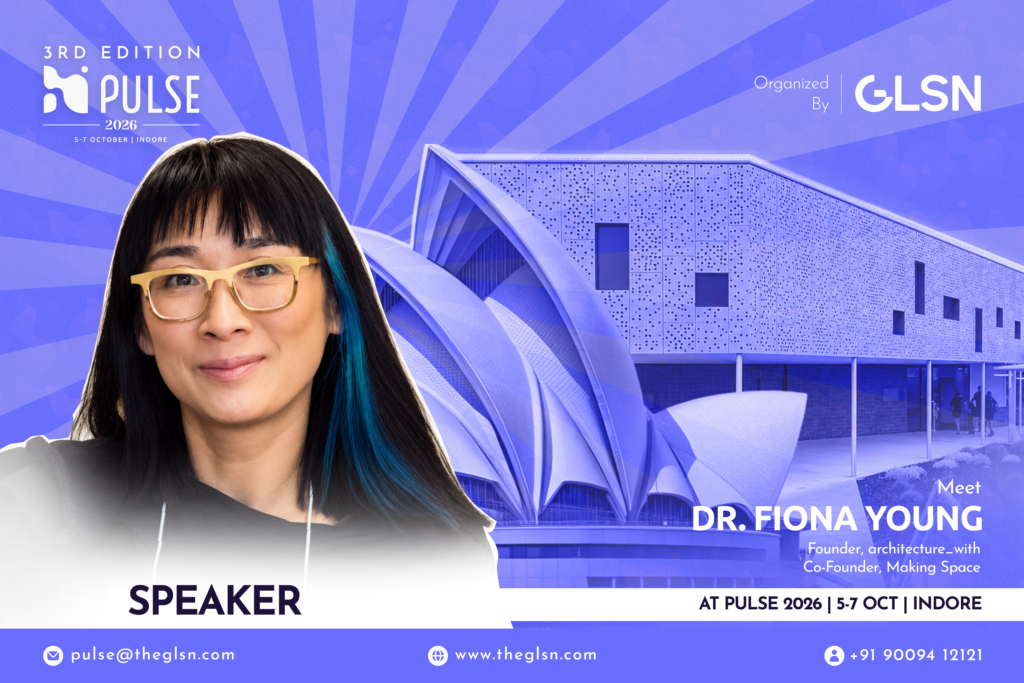
MEET THE SPEAKER
A beautifully designed learning space is only the beginning. What happens when people begin to use it?
Schools are investing in flexible classrooms, collaborative spaces and innovative learning environments. Yet, too often, the challenge begins after the building is complete.
Are educators equipped to use the space differently?
Does pedagogy evolve with the environment?
Can a space designed for collaboration actually enable better collaboration?
These are the questions at the heart of Dr. Fiona Young’s work.
Meet Dr. Fiona Young
An architect, researcher and learning-environment specialist, Fiona works at the intersection of architecture, pedagogy and practice. She is the Founder of architecture_with and Co-Founder of Making Space, an award-winning initiative helping educators develop the spatial literacy, strategies and confidence needed to activate collaborative learning environments.
Her research explores the affordances of innovative learning environments- looking closely at how spatial qualities can support different ways of teaching and learning, and where the intentions of architects and the realities of educators may diverge.
The Design-Use Gap
What happens when the space is innovative, but the practice remains traditional?
This design-use gap is one of the most important challenges in contemporary learning environments.
Fiona’s work addresses what happens in that space between design intent and lived experience- helping school communities understand not just what a space can offer, but how it can actually be used to transform learning.
Her work across Lindfield Learning Village, Evelyn Scott School, Domremy College’s Nano Nagle Learning Centre and Project X at Ballina Coast High School brings these questions into real educational settings.
At Project X, students were also involved in shaping their environment, demonstrating how participatory design can influence both space and school culture.
What Fiona Brings to PULSE
At PULSE 2026 | Where Culture Meets Learning, Fiona brings a much-needed perspective:
Designing the space is not the same as designing the experience.
Her conversation will explore how schools can:
- Bridge the gap between architecture and pedagogy
- Build spatial literacy among educators
- Help teachers move confidently into innovative learning environments
- Involve students and educators in shaping the spaces they inhabit
- Design environments that can adapt to people, practice and culture
For architects, educators and school leaders, the takeaway is both practical and challenging:
How do we make sure the spaces we design don’t simply look different- but enable learning to happen differently?
That is the conversation Fiona Young brings to PULSE.
PULSE 2026 | Where Culture Meets Learning
5–7 October 2026 | Sheraton Grand Palace, Indore
Dr. Fiona Young, we look forward to welcoming you to PULSE 2026.