
Author: Cedric Ryckaert, Teacher, Sint-Paulus School in Kortrijk, Belgium
Co-Author: Marc Verachtert, Freelance Journalist, Belgium
Sint-Paulus is an primary school in the middle of the city of Kortrijk in Flanders, Belgium. The school celebrates its 125th anniversary this year and provides education to 500 children. There is a staff of 45 teachers at work.
In 2024, the school was elected as TOP 3 in the World’s Best School prizes by T4 Education and in 2023 the school has won the New European Bauhaus Award, awarded by the European Commission with it’s school ground project ‘Klimaatspeelplaats’ . This project has set the benchmark for greening school grounds all over Belgium and is inspiring schools all over the world to rethink their school grounds. By getting rid of concrete and finding solutions for water issues, heat stress and increasing biodiversity the school has become a leading example for many schools.
The primary school Sint-Paulus in Kortrijk does not just have a green playground, it has a climate playground. Cedric Ryckaert is teacher at the school, inspirer of this climate playground and meanwhile also messenger so that this kind of school ground becomes more rule than exception.
Box: What is a climate adaptive school ground?
A climate adaptive school ground goes for smart handling of rainwater, offers greenery to create a pleasant, playful environment, allows discovery and learning experiences, teaches respect for the environment and introduces to a multitude of aspects of climate and environment.
Context: Flanders is a region in Belgium (EU). It has the most paved surface area in Europe. Every day, 7ha of new paving is added. The Flemish government has been working for years to stop this paving. Schools could use subsidies to soften and green their playgrounds in recent years. Sint-Paulus was one of the pioneers in 2018 to get started with these funds.
From grey to green
Five years ago, the school ground at Sint-Paulus school in Kortrijk looked as drab and grey as so many other playgrounds in Flanders and the whole world. Only the railway embankment next to the school was coloured green. Balls and other play equipment were brought in according to weather and other conditions. It could never be for everyone and to everyone’s liking. Cedric Ryckaert, then relatively new to the school, suggested a change. ‘I was teaching first grade then. Not for long yet, as I am a lateral entrant with a past in youth work. There, play is incredibly important. It is the solution to many problems including bullying and teasing. Yet in most schools, play is pushed to the margins.
Green plans
The commitment to play here could have led to a playground filled with sports equipment. But we took our time to develop a strong plan. It took four years before our plan was ready for implementation. We involved our students, parents, teachers and local residents in the plans. This inertia was crucial. We visited good examples at home and abroad and, in the meantime, conducted our own playground research on air quality and soil pollution. Especially after visiting Berlin’s green schoolyards in 2017, we returned with a strong idea of what our future playground should look like. Windfall or setback? Turned out that like the buildings, the entire sewage system had been constantly expanded and connected over the years. So there was no separate drainage and proper sizing. It made the decision to tackle the school ground thoroughly much easier. Everything would be brought on point all at once. The school board pitched in to help realise the plans.
However, it soon became clear that professional support was needed. It resulted in detailed and at the same time bold plans from landscape architects Studio Basta and Fris in het landschap. ‘They were so well presented and substantiated that we succeeded in convincing others and loosening grants as well.’ IIt made communication with our school community easier and they took the pace from us as teachers.
Vision on play
What we first developed as a school team was a vision about play. A strong vision of play is the foundation of a strong school ground. Thus, we wanted to give space for every kind of play, every child should be able to come to play and play should be adventurous and safe. Within this framework, we designed our playground. Now we see that the breaks for the children lead to enormously varied play. Whereas on our old playground we saw about 5 play varieties (mainly ball games), now we quickly notice 20 to 30 different types of play. Which naturally leads to less boredom and this has thus led to a huge reduction in conflicts on our playground. You must know that children on our ground play outdoors for about 2 hours a day. That means around 3000 hours in total in the school career of kids on our school ground. This is huge!
Rainwater is useful water
What changed underground you don’t see today. And yet it is an important part of the school ground. The roof drains have been disconnected from the sewage system. Today, rainwater is buffered and reused for sanitary use. For this, collection capacity of 150 000 litres of rainwater has been installed. Including the water playground that the children enjoy in summer. What cannot be buffered infiltrates, as does all the water that ends up on the pieces of still-paved playgrounds. It can go left and right into the planting. This makes the school ground a giant sponge for water. Striking in this respect: paving never bumps against the classroom walls overlooking the playground. ‘There is always an edge of green between wall and playground, so that children have a green foreground when looking outside’. The reason is obvious: greenery brings calm, enhances concentration and thus helps children stay better focused in lessons.
Stone or green?
Although not noticeable, more than half of the play area is still paved. ‘The playground has to be playable in all conditions, even in bad weather. And we necessarily wanted to keep football or other ball games possible. Moreover, at our school you also have to take into account school parties for which paved space is needed and, of course, a solid access for logistics and -though we hope it will never be necessary- for fire brigades and ambulance.
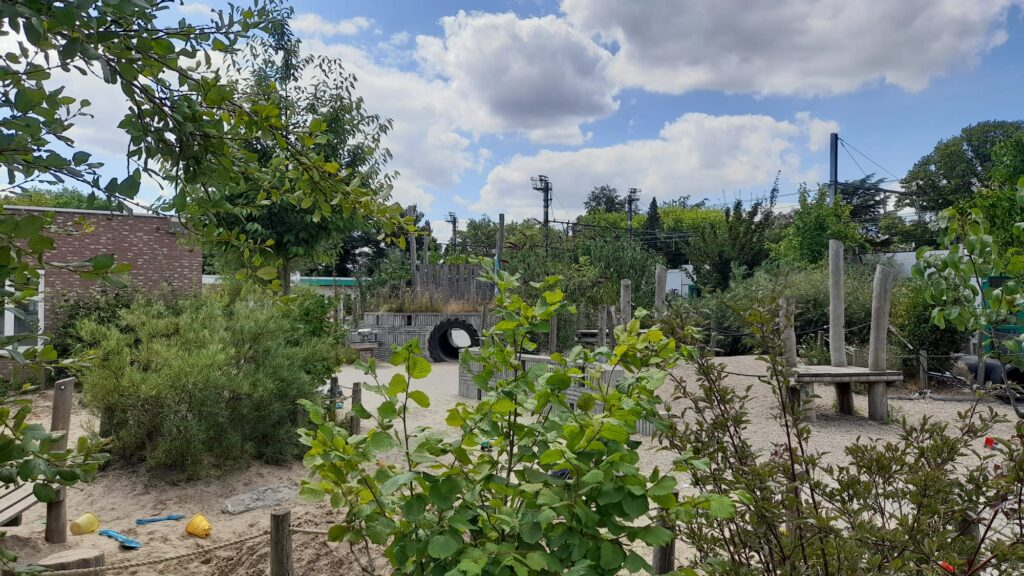
The green spaces, accounting for at least 60 per cent of what you may call play space, are mainly scattered throughout the space as islands. Sometimes they serve to divide spaces, other times as ground and background for a seating wall or stand, other times as outright invitations to play or large volume on which robust, natural-looking play equipment stands or tunnels and even a secret cave is hidden underneath.
Robust greenery
Trees and shrubs form the robust framework of the green areas and were given a colourful background of flower mixtures. The trees were chosen and planted in such a way that they will later go through life as shade trees. Five of them additionally grow into play trees. ‘We started choosing them at a specialised nursery based on their shape and character’. Each grade could send one ambassador to choose a tree. Also on the playground are fruit trees and berry bushes. ‘The fact that the fruits cannot ripen does not bother anyone. They bloom and grow and show stages that are otherwise hidden from city children’. In the playground, there are also willow tunnels. ‘Built together with the children. Everything that grows here can take a beating and has great self-healing ability, see rosemary willow, butterfly bush and hazel among others. Toxic plants definitely do not belong here. Neither are plants that require a lot of maintenance.
4,000 m², 40 hours of maintenance
The school playground, which covers 4,000 m², of which about 2,500 m² is a real playground, needs 40 hours of maintenance per year. This is provided by the Kortrijk city green space department. This is in return for opening up the playground to families, groups and associations outside school hours. It is busily used, creating a win-win situation for school and neighbourhood!
Safer play
Green on the school ground knows high play pressure. Yet it should be given a chance to grow and become robust. It was solved here by installing a rope around the planting areas. ‘Children know not to cross it. It’s one of the three rules we ask them to respect: the other two are: don’t throw objects and don’t use words you wouldn’t say to grandma or grandpa.’ ‘We also see that play has become softer and there is less boredom’. In fact, the contours of the green islands are game leaders in their own right. Children run courses, have more challenging games and can also play games like hide and seek more easily. Of course, this also brings us to teacher supervision and acceptance. ‘Even though we don’t see the children all the time, we have to make fewer adjustments. And if they need us, they know we are there’. The teacher now also take a break when they are doing surveillance. They work in the school for their whole career. They deserve also a beautiful working environment!
Additional learning opportunities
Teachers have gained a lot of extra pedagogical and educational opportunities with the climate playground. ‘We no longer have to go to the park or forest to talk about blooms and blossoms or autumn colouring and falling leaves. The playground goes for constant and very varied offerings. Even the cycle of water is part of it’.
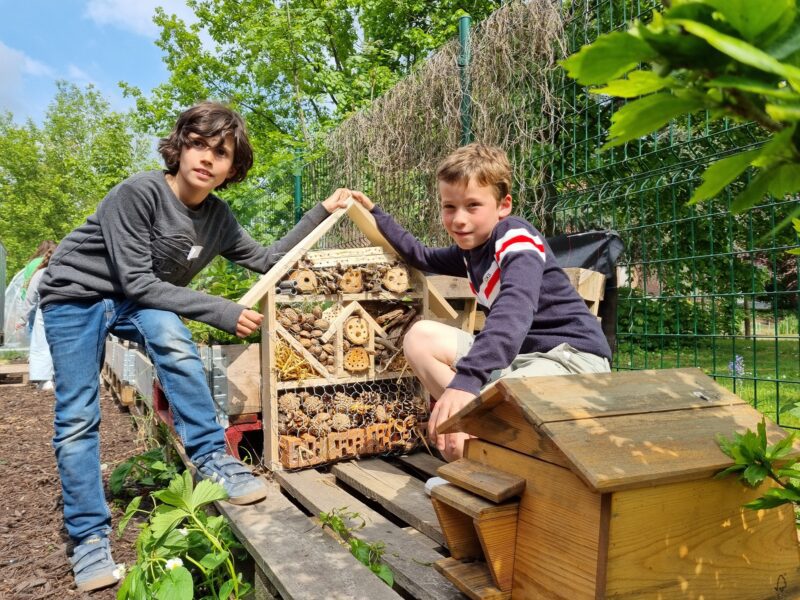
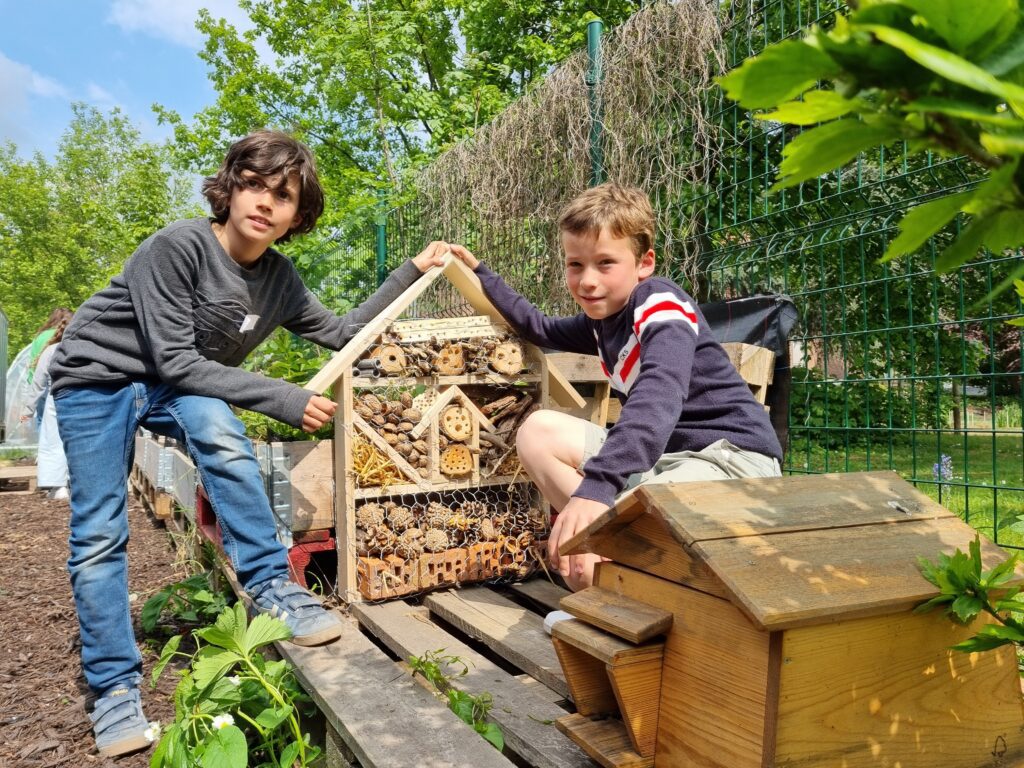
Very often, projects are also set up. Even for toddlers and first graders. For example, they have already taken stock of what animals live on their playground. Where possible, links are also made with current affairs. The bird counting weekend, for instance, is an occasion for feeding birds, using binoculars, identifying species. And when it comes to understanding the plant world, the herb fields make a lot possible, including learning to use plant apps. On the roof there is a weather station and in the bird boxes you can follow budding life via wildlife cameras. Its own vegetable garden is also very popular. Children are actively involved in growing plants and healthy food.
Chicken farmer and beekeeper
In a somewhat separate area, near the teachers’ car park -a car park that was suddenly softened and thus made water permeable as part of the project – there is even a chicken coop and a house with beehives. ‘The chickens are managed by the sixth grade. The teachers use them to make maths lessons extra engaging, for example. For instance, the children weigh the feed they give and put it into statistics against the number of eggs they collect.’
Pupils are also involved in beekeeping. ‘The school has child-sized beekeeper suits, so bees no longer hold any secrets for them and they learn how important they are for plant life and food production.’ And the honey? That is on sale as school honey during school parties and open days.
Inspiration for other schools
The school received a lot of interested visitors in recent years. It led to the launch of a new organization called BLES. Cedric was one of the pioneers of this network. BLES is a network of landscape architects, teachers and experts in outdoor play and learning. They now support dozens of schools in softening and greening their school grounds in Flanders. Flemish schools, following Sint-Paulus’ example, are massively greening their school grounds. The support of the Flemish government further accelerates this movement. Sint-Paulus’ story is also being eagerly picked up internationally. School teachers travel around to share the story to inspire. The whole story can also be found on the project’s website: www.klimaatspeelplaats.be.
Green future
In the longer term, this kind of playground will hopefully become the norm. It is hoped that school construction will always start from a green school environment and that schoolyards will no longer simply be concreted. The effect of the playground on pupils is striking: children are more respectful of nature and the environment, and school coexistence has also only improved. We assume that what they learn and experience here will carry with them into the rest of their lives. We know that all over the world many schools and teachers are working on this. Organisations such as The International School Ground Alliance, BLES (BE), Learning Through Landscapes (UK), IVN (NL), Patio Vivo (Chile), Children & Nature Network (USA) are putting a lot of effort into this. It would be great if every child in the world could grow up in a nature-rich school. Governments should therefore put their backs into this. If we want our children to care for their environment, they will have to learn to know and understand it. And where better to do that than on a green school ground?
Featured Project: Climate Adaptive Schoolground, Sint-Paulus School, Belgium
Photography: Studio Basta

The views expressed in this article are those of the author and do not necessarily reflect those of GLSN.