
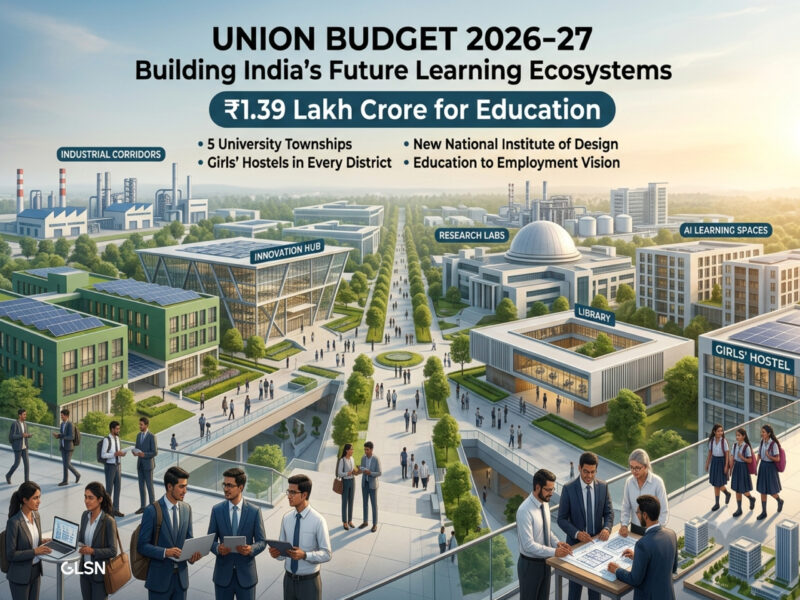
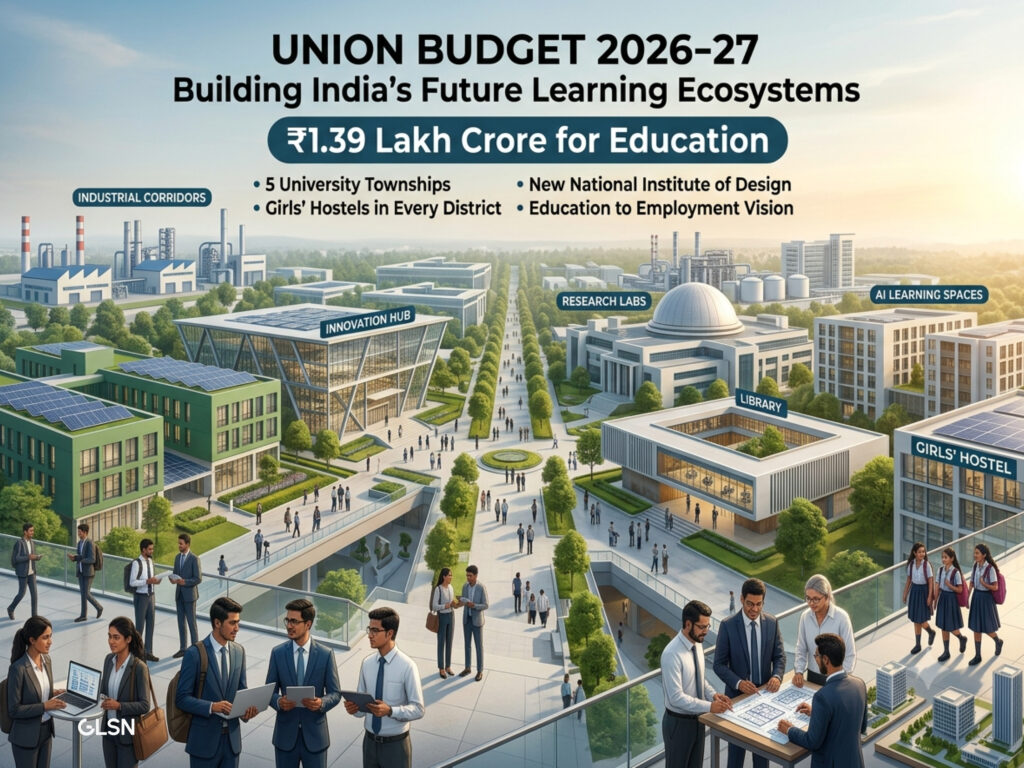
With ₹1.39 lakh crore allocated to education, the Union Government is betting on university townships, design education, STEM infrastructure and stronger industry-academia collaboration to prepare India for the future.
The Union Budget 2026–27, presented by Finance Minister Nirmala Sitharaman, places education at the heart of India’s long-term economic vision. Beyond an 8.27% increase in the education budget, the announcements point towards a larger transformation—one where universities, industries, research and innovation evolve together rather than in isolation.
Among the biggest announcements are the creation of five University Townships, a new National Institute of Design (NID) in eastern India, district-level girls’ hostels, upgraded astronomy infrastructure, and a new national committee to bridge education with employment and enterprise.
Budget at a Glance
- ₹1,39,285.95 crore allocated to the Ministry of Education—an 8.27% increase over the previous Budget.
- ₹83,562 crore earmarked for School Education.
- ₹55,727 crore allocated to Higher Education.
- Five University Townships proposed major industrial and logistics corridors through a challenge-based model with states.
- High-Powered “Education to Employment and Enterprise” Standing Committee to align education, skills, AI readiness and employment.
- One new National Institute of Design (NID) proposed for eastern India.
- One girls’ hostel in every district through Viability Gap Funding (VGF) and capital support.
- Four national astronomy facilities to be established or upgraded, including the National Large Solar Telescope, National Large Optical Infrared Telescope, Himalayan Chandra Telescope, and COSMOS-2 Planetarium.
The Biggest Shift: University Townships, Not Just Universities
The proposal to establish five University Townships is arguably the Budget’s most transformative education announcement.
Planned around India’s major industrial and logistics corridors, these integrated academic zones are expected to bring together universities, colleges, research institutions, skill centres and residential communities—creating ecosystems where education is closely connected with innovation, manufacturing and employment.
While the government is yet to announce the final locations, the initiative is expected to support emerging economic corridors and strengthen regional talent pipelines through a competitive, challenge-based partnership with state governments.
From Vision to Implementation
The proposed University Townships are already moving beyond a Budget announcement into active planning. Introduced in Paragraph 62 of the Union Budget 2026–27, the initiative is currently in its framework development phase, with the Ministry of Education, in partnership with MyGov, inviting public feedback to help shape its implementation. The final locations will be selected through a challenge-based model, where states compete based on land readiness, infrastructure and connectivity to key industrial and logistics corridors.
More than new campuses, these townships are envisioned as integrated learning ecosystems—bringing together universities, research centres, skill hubs, innovation spaces and residential communities. By locating them alongside major economic corridors, the initiative aims to foster closer industry-academia collaboration, strengthen regional talent pipelines and create learning environments that are directly connected to India’s future growth.
Education Meets Employment
Recognising the changing nature of work, the Budget also proposes a High-Powered ‘Education to Employment and Enterprise’ Standing Committee.
Its role will be to assess future workforce requirements, study the impact of Artificial Intelligence (AI) on jobs and skills, and recommend strategies to strengthen India’s services sector—supporting the country’s ambition of achieving a 10% share of the global services economy by 2047.
Design, Inclusion and STEM Receive a Push
The Budget also expands its focus beyond conventional higher education.
A new National Institute of Design (NID) is proposed for eastern India to strengthen India’s growing design ecosystem, while the announcement of one girls’ hostel in every district aims to improve access to higher education, particularly for women pursuing STEM courses.
Complementing these measures is the upgrade of four national telescope and astronomy facilities, reinforcing India’s investment in scientific research, experiential learning and advanced STEM education.
What Still Needs Clarity
While the vision is ambitious, several questions remain unanswered.
The government is yet to specify the locations of the five townships, the funding structure between the Centre and States, implementation timelines, governance models, or how these integrated education hubs will measure long-term success.
Their impact will ultimately depend not only on investment, but also on planning, collaboration and execution.
Why This Matters to GLSN
At GLSN, we believe the future of education is shaped by the environments where learning happens.
The University Township model reflects a growing global movement towards place-based learning, where campuses, research, communities and industry function as a connected ecosystem rather than isolated institutions.
If realised thoughtfully, these initiatives could redefine how India designs learning spaces—making them engines of innovation, collaboration and regional development, rather than simply centres of instruction.
