
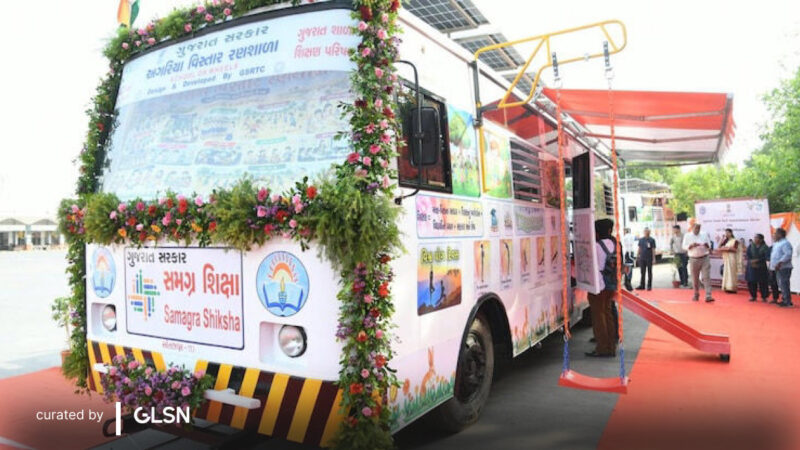
In the remote landscapes of Gujarat’s salt-producing regions, where seasonal migration often creates a gap between children and classrooms, a unique educational model is rewriting the meaning of access.
A retired bus. A solar-powered learning space. A classroom that travels.
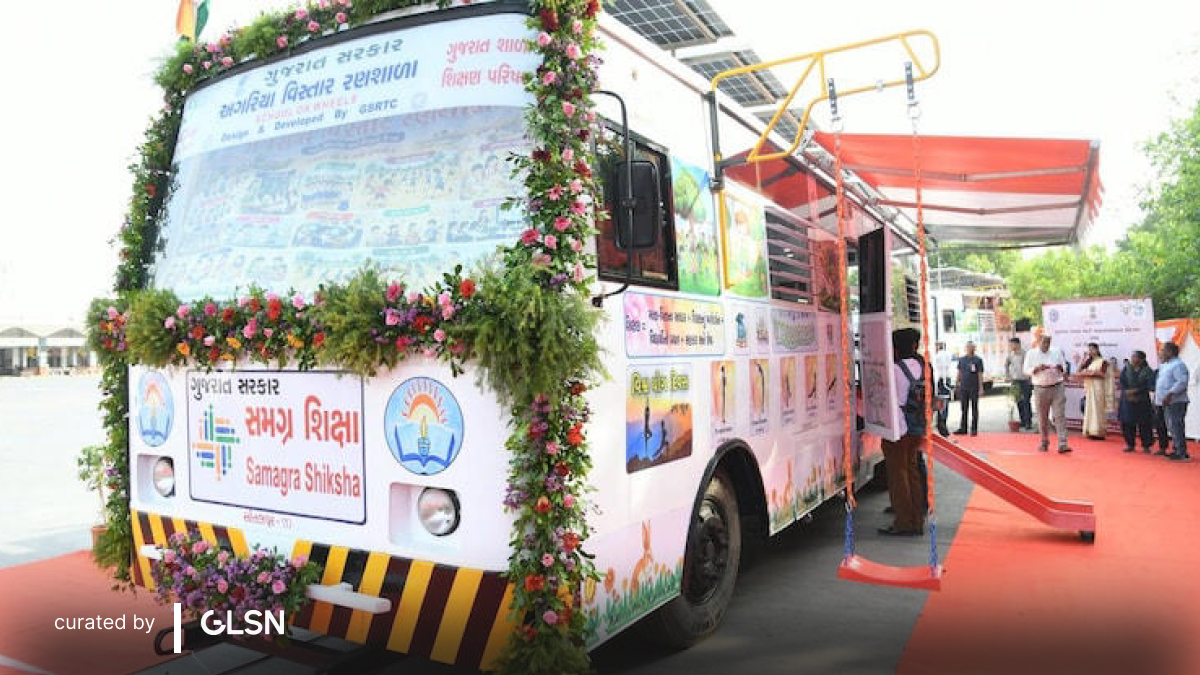
Gujarat has introduced “School on Wheels” – locally known as Ranshala, an initiative that transforms 28 unused Gujarat State Road Transport Corporation (GSRTC) buses into fully equipped mobile classrooms for children from Agariya salt-worker communities.
The initiative is designed to ensure that migration does not interrupt childhood learning and that education continues to reach children, even in the most challenging environments.
From Transport Buses to Learning Spaces: A New Approach to Educational Access
The mobile classrooms were officially launched from the Pathikashram State Transport Depot in Gandhinagar during the state’s Shala Praveshotsav school enrolment campaign. The buses were flagged off by Minister of State for Home, Harsh Sanghavi, who highlighted the project as an example of turning available resources into meaningful social infrastructure.
Speaking about the initiative, Sanghavi explained how unused GSRTC buses were given a new purpose through this education-focused transformation.
He shared that the project demonstrates how public resources can be redesigned to serve communities that face accessibility challenges. According to him, the initiative creates a direct connection between classrooms and children living in remote desert settlements. He said: “More than 20 children can study inside each bus, which is equipped with television and Dish TV facilities powered by solar energy. These children will also benefit from online classes conducted by the Gujarat Government.” He further added that these converted buses will help children of salt-worker families access learning without travelling long distances.
The larger vision, he explained, is to ensure that no child living in remote areas is disconnected from education because of location or circumstances.
Understanding the Need: Education in the Middle of Migration
The idea behind Ranshala comes from the realities of the Agariya community.
Every year after the monsoon season, many salt-producing families move towards areas such as the Little Rann of Kutch, where they spend several months working near salt pans and temporary settlements.
For children growing up in these conditions, continuing formal education becomes difficult. Long distances, changing locations and limited infrastructure often create interruptions in schooling.
The “School on Wheels” initiative addresses this challenge by bringing the classroom closer to where children live.
Instead of children adapting their lives around schools, this model allows education to adapt around children.
A Mobile Classroom Designed Beyond Four Walls
These buses are not simply converted vehicles – they have been designed as complete learning environments suitable for remote desert conditions.
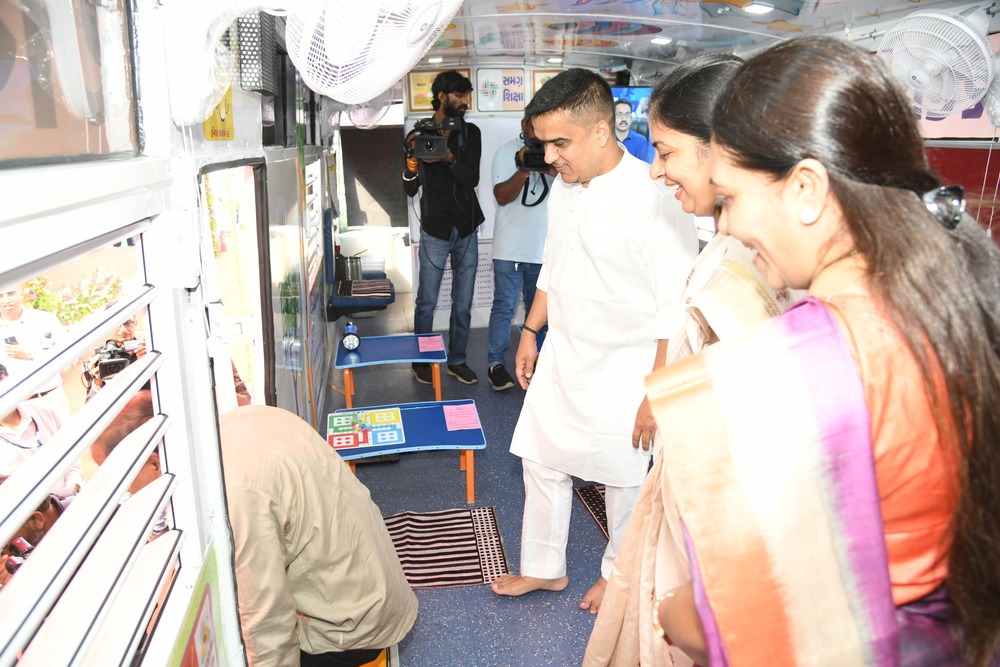
Each mobile classroom is equipped with:
- 3.8 KVA off-grid solar power systems, allowing operation for up to 48 hours without external electricity
- 43-inch smart televisions
- Digital learning content through educational channels
- FM radio facilities
- LED lighting systems
- Wall-mounted fans
- Portable study tables
- Flexible seating arrangements
- Foldable outdoor shade nets for expanded learning areas
- Detachable blackboards and whiteboards
- Notice boards
- Teacher cabins
- Dedicated library spaces
The classrooms also include essential facilities to support children’s overall development, including:
- Purified drinking water systems
- Wash basins
- Water storage tanks
- Hygiene and sanitation facilities
The design goes beyond academics by creating an environment where children can learn, interact and enjoy the learning experience.
Recreational elements such as Ludo, Snakes and Ladders, model clocks, swings, slides and basketball equipment have also been included.
Health monitoring facilities such as digital weighing machines, height measurement systems and BMI charts have been added to support children’s wellbeing.
Safety features include emergency exits, fire extinguishers, first-aid kits and sanitation systems.
A Collaborative Model for Inclusive Learning
The project has been implemented through a collaboration between Samagra Shiksha, the Education Department and GSRTC, focusing on children between 6 and 14 years from families involved in seasonal salt production.
The 28 mobile classrooms have been distributed across key regions:
- 20 buses in Patdi taluka, Surendranagar district
- 4 buses in Santalpur, Patan district
- 2 buses in Anjar, Kutch district
- 2 buses in Malia, Morbi district
The objective is to reduce educational disruption and support children who are vulnerable to school dropout because of migration.
Why This Innovation Matters for the Future of Education
The future of learning is not only about advanced technology, modern campuses or innovative buildings. It is also about creating flexible systems that respond to communities. The “School on Wheels” initiative represents an important shift: Education is no longer limited to a fixed location. It becomes a journey – one that reaches learners wherever they are. Across India, many children continue to face barriers due to geography, migration, climate and accessibility. Initiatives like Ranshala open a larger conversation: How can we design education systems that are more inclusive, adaptable and connected to real human experiences? Because every child deserves access to learning – whether their classroom stands inside a building or travels across the landscape to find them.
