
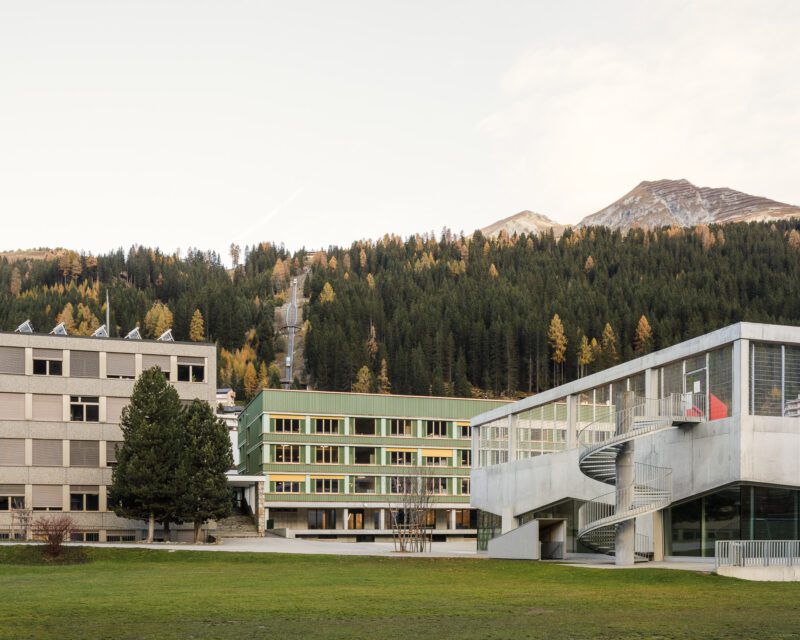
Shared by the architects upon our invitation.

Vision:
The vision for the Davos School Campus was clear from the very beginning: to
implement a contemporary, flexible, and future-oriented school concept within an
existing 1960s building. Through careful analysis of the existing structure and a
deep understanding of users’ needs, it became possible to transform the rigid,
outdated building into an open space of communication.
Students are multifaceted, vibrant, introverted, extroverted, and diverse. It is therefore essential to understand the building as a learning landscape that can function as both an individual and collective place of learning. These core principles are supported by natural and ecological materials, creating a pleasant and positive indoor environment that helps students feel comfortable and enjoy spending time at school.
It is precisely this understanding that has made the Davos School Campus a
forward-looking project – one that serves both current and future generations.
Context:
Davos, a well-known spa and vacation resort in Switzerland, is located in the
canton of “Graubünden” in the east of the country. At an altitude of around 1,560
meters above sea level, Davos is considered the highest town in Europe and
attracts numerous visitors every year thanks to its impressive alpine location.
The special climatic conditions have led to a unique architectural language in this
region over the years. For example, no roof pitches are permitted in the town
center due to the masses of snow that could endanger the people near the
building. In the project, it was important to find a balance between the typical
local architecture and a contemporary expression. As an example, the diamond
shape of the so-called sgraffito of the old “Bündner”-houses was incorporated into the façade of the new school building and therefore becomes a part of the cultural history and unity.

The school complex in Davos Platz is converting its operations to a daycare
structure and therefore requires additional space for an assembly hall, cafeteria,
administration and extra classrooms. For that reason the existing building from the 1960s was to be demolished in favor of a new ecological building. In order to
preserve the embodied energy, an integrative solution with the existing building
was proposed instead, in which the old structure is extended on the long sides and a storey is added to meet the growing requirements of the program.

To do so, a new structure is placed over the entire existing building and completely encloses it with a new shell, which both meets the thermal requirements and pursues a new aesthetic standard. From the outside this hybrid appears to be a new building, while actually 40% of its volume consists of the existing structure.

The extensions are constructed from an efficient timber grid, which is based on the wall axes of the existing building. The third floor, which has been added on top of the old roof, is carried off via the lateral extensions, which means that no additional load is placed on the existing structure.
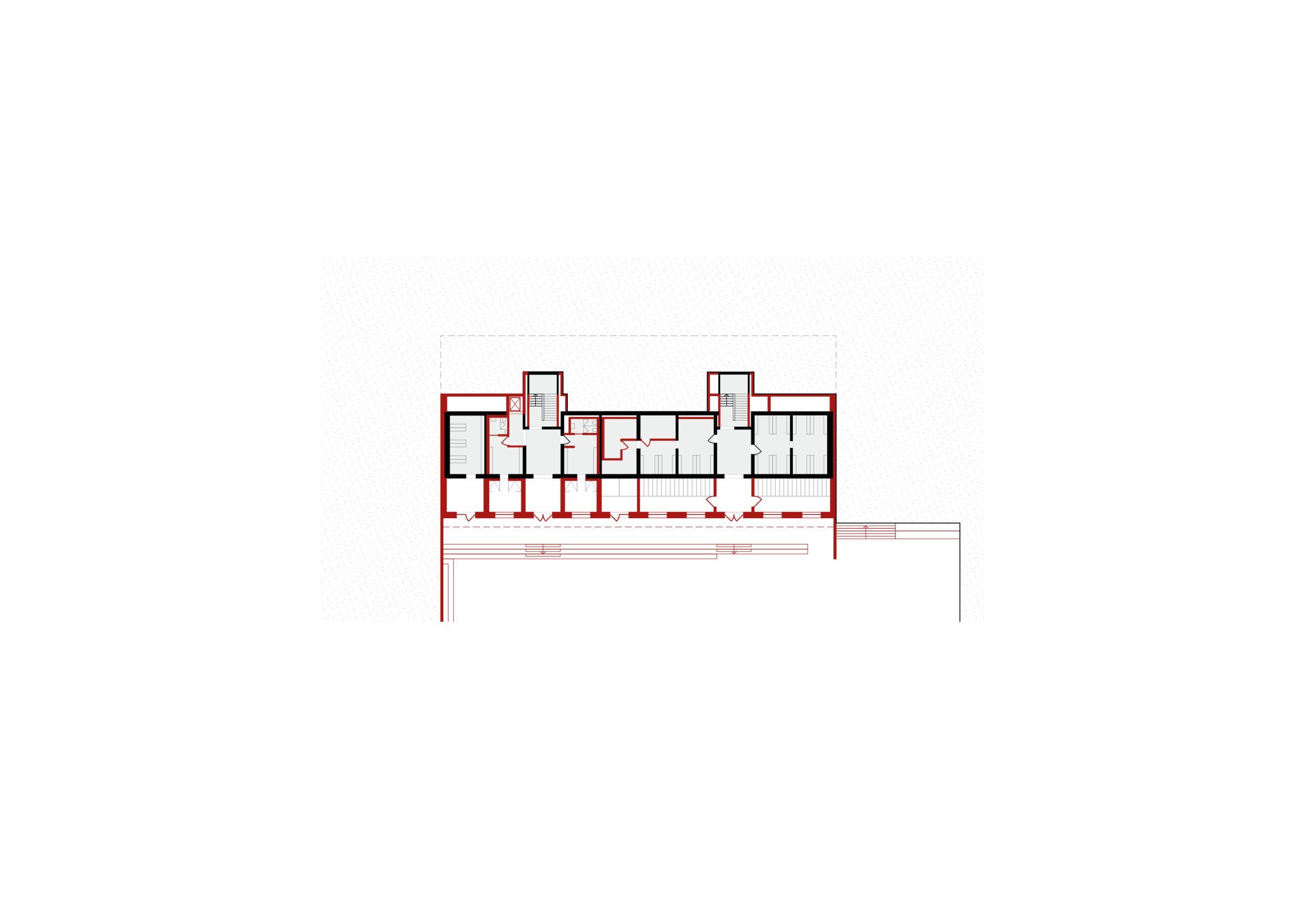
While the public first floor is oriented towards the schoolyard, the classrooms and offices on the upper floors are arranged around a central communicative atrium.
Together with the versatile corridor areas, this offers a variety of individual
learning and retreat options, which enrich the traditional school operations in many different ways.

The new part facing “Schulstrasse” is connected to the existing staircase landings, which means that the new and old buildings are each offset by a half storey. The extension towards the schoolyard allows to shift the classrooms away from the cores, resulting central circular route inside the building, where you can playfully switch between the existing and new building on each mezzanine floor.

On the third floor, a new roof garden has been implemented for school activities
and serves as a “green classroom” that gives the possibility for new and creative
educational concepts – accompanied by a panoramic view in the Swiss mountains.

Sustainability Concept:
While a quarter of all CO2 emissions currently come from the building sector, every new building is faced with the task of ensuring resource-saving construction and energy-saving operation. Although the existing school building from the 1960s was no longer functional or structurally viable, it was well positioned in terms of urban planning and had a solid and flexible structure. It was therefore a matter of course to retain the existing building components and use them to design a concept for an extension.
This meant that almost 40% of the load-bearing structure in the new building and
the staircases could be saved, which has a significant impact on resource
consumption and CO2 emissions.
All new extensions were built in timber, which means that the building functions as a long-term CO2 store. As the solid existing structure has sufficient thermal mass, an efficient heat storage in the new lightweight construction is unproblematic.
For all newly constructed parts of the building, the focus was on using regional and renewable building materials.
The open timber structure, the massive wood ceilings with sheep’s wool acoustics and the cork floorings create a cozy atmosphere and form a counterpart to the massive concrete structures of the existing building. Therefore, a conscious distinction was made between old and new components so that the conversion process remains visible to the students.

The integral low-tech concept makes it possible to avoid controlled ventilation. All
learning and working areas can be cross ventilated by opening both the windows to the outside and to the central atrium. This nine-meter-high room can be opened up to the roof garden and acts as a kind of natural chimney. The building’s own energy requirements are covered by a geothermal system and PV modules.
Challenges & Solutions:
The greatest challenges of the project were the tight schedule and building in an
alpine environment with its weather-related difficulties. The close and cooperative collaboration with the craftsmen and the client made it possible to complete the construction project efficiently and without any delay.
Project Gallery:




Cite: “School Center in Davos Platz, Switzerland / CURA Architekten 28 January 2026. GLSN. Accessed . https://theglsn.com/school-center-davos-platz-switzerland-cura-architekten/